


Super Ace vs Super Ace 2 vs Super Ace Deluxe: What's the difference?

Updated: Oct 13

Anyone researching super ace vs super ace deluxe may notice that another title, Super Ace 2, frequently appears alongside them. That can make the three games seem interchangeable, particularly because they share a similar card-themed presentation and core slot format.
They are, however, distinct titles.
At the foundation, each game uses five reels, four rows, and 1,024 ways to form winning combinations. The similarities largely stop there. The way Golden Symbols and Jokers function, how wins build multipliers, and the potential maximum payout vary between versions.
There is also official evidence that the names refer to separate games. PAGCOR's March 2026 approved-game list records SUPER ACE under Game ID 49, SUPER ACE 2 under Game ID 542, and SUPER ACE DELUXE under Game ID 403. All three are separately identified as slot games.
For anyone looking for the quickest explanation of the super ace game differences, here is the basic picture:
Super Ace represents the original documented entry in the series. Its gameplay features Golden Cards, Joker transformations, and a Combo Multiplier that increases during successive wins.
Super Ace 2 introduces the Stacked Golden Joker while retaining the familiar foundation of the series. JILI lists medium volatility and a maximum win of 10,000× for this version.
Super Ace Deluxe uses a Star Card feature to alter regular card symbols into Golden Symbols on reels 2, 3, and 4. Those Golden Symbols can later turn into Jokers after being eliminated. Its documented multiplier can reach 10× in the base game and 20× during free games, with a maximum win of 10,000×.
These differences become clearer when the three games are examined individually.

How Super Ace, Super Ace 2 and Super Ace Deluxe differ
The easiest mistake when comparing super ace, super ace 2, and super ace deluxe is to focus on the reel layout. Since all three use the same 5×4 arrangement and 1,024 ways, the grid itself does not tell you much about which version you are playing.
The feature mechanics are more revealing.
Super Ace
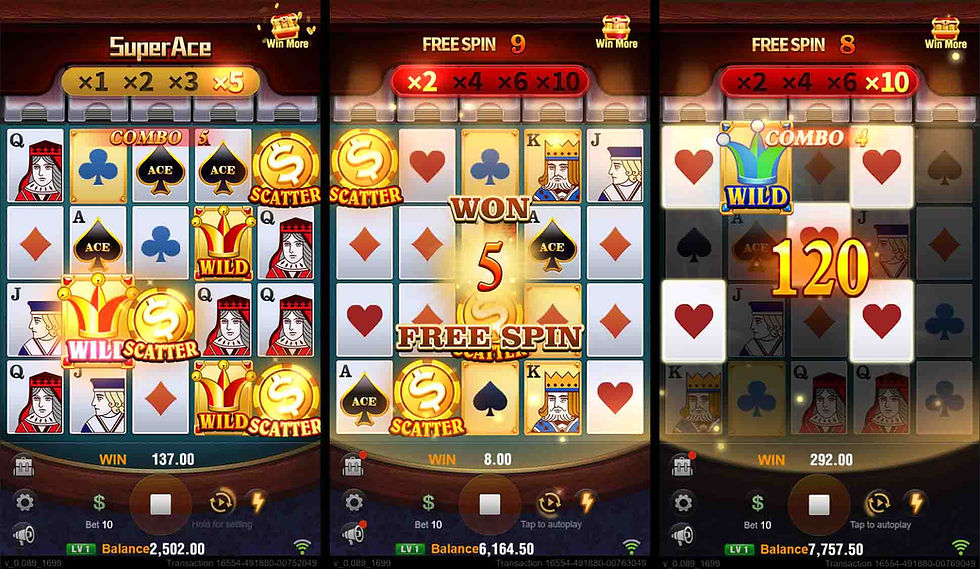
The original Super Ace has a documented maximum win of 1,500×. Its Combo Multiplier begins at x1 and can progress through x2, x3, and x5 in the regular game.
The free-game feature uses a separate progression: x2, x4, x6, and x10. Three or more Scatters award 10 free spins, while the applicable Scatter condition during free games can provide additional spins.
Golden Cards and Joker transformations are central to the game's feature system, giving the original title its characteristic combination of symbol changes and consecutive-win mechanics.
Super Ace 2
Super Ace 2 takes the established formula and changes the special-symbol behavior with its Stacked Golden Joker feature.
Its underlying format remains familiar: five reels, four rows, and 1,024 ways to win. However, its documented specifications are notably different from the original. JILI lists Super Ace 2 with medium volatility and a maximum win of 10,000×.
That makes the second entry more than a simple renamed version of the first. Its distinguishing feature is the Stacked Golden Joker mechanic layered over the same general reel framework.

Super Ace Deluxe
The feature system in Super Ace Deluxe is built around the Star Card.
When the relevant feature applies, regular card symbols appearing on reels 2, 3, and 4 can be converted into Golden Symbols. Once those symbols are removed, they can transform into Jokers, creating another layer of interaction between consecutive wins and special symbols.
The multiplier system is also extended compared with the original game. JILI documents cumulative multipliers reaching 10× in the base game and 20× in free games. Three Scatters trigger 10 free games, and the listed maximum win is 10,000×.
This gives Deluxe a feature set that is recognizably part of the Super Ace family while still making it mechanically distinct.

What the three games have in common
The strongest point of similarity across the super ace jili titles is their basic reel configuration.
The original Super Ace is documented as a video slot with five reels, four rows, and 1,024 ways to win. JILI's documentation gives Super Ace 2 the same 4×5 arrangement and 1,024 ways.
Super Ace Deluxe also uses five reels and four rows, with 1,024 ways to win.
That common structure explains why the games can feel familiar when compared side by side. Players do not have to learn an entirely different reel system each time they move between versions.
Instead, the major gameplay distinction comes from what the games do with winning symbols.
In the original Super Ace, a winning combination causes the relevant symbols to be removed. New symbols then occupy the empty positions, allowing the resulting arrangement to be checked for another possible win. This creates a continuing sequence in which successive wins can interact with the game's multiplier mechanics.
The later versions build on this general concept but add their own feature systems. Super Ace 2 uses the Stacked Golden Joker, while Super Ace Deluxe brings in the Star Card and its Golden Symbol-to-Joker interaction.
Therefore, when comparing the three titles, the reel dimensions are only the starting point. The more meaningful super ace game differences are found in the special-symbol mechanics, multiplier progression, free-game behavior, and documented maximum-win specifications.

How the original Super Ace works
To understand the super ace game differences, it helps to start with the first release. The original Super Ace JILI game introduced the Golden Card and Joker mechanics that form the basis for several features seen in its successors.
Golden Cards and Golden Symbols
Golden Cards are capable of landing on reels 2, 3, and 4. When a Golden Symbol is part of a winning elimination, the symbol can change into a Joker. Before this transformation takes place, the Golden Symbol can also substitute for the applicable regular symbol when forming a winning combination.
In practical terms, the mechanic follows this progression:
Golden Symbol → elimination from a winning combination → Joker
The resulting Joker works as a Wild symbol. It can substitute for eligible regular symbols, but it cannot take the place of a Scatter.
Big Joker and Little Joker
The original Super Ace also has two Joker outcomes: the Big Joker and the Little Joker.
The Big Joker can appear across reels 2 to 5 and replace a randomly selected group of eligible symbols. The Little Joker is associated with the position previously occupied by the Golden Symbol.
Although their appearances and effects differ, both are Wild-type symbols. Neither can substitute for a Scatter.
Combo Multipliers
The original Super Ace increases its Combo Multiplier when winning eliminations continue from one stage to the next. The base game uses four multiplier levels:
x1
x2
x3
x5
The sequence starts at x1. Continued winning eliminations can move the multiplier upward, but once the winning sequence finishes, the multiplier resets for the next spin.
Free Games use a separate, doubled progression:
x2
x4
x6
x10
Three or more Scatters trigger 10 free spins. During the Free Game feature, another three Scatters can provide additional spins.
These mechanics are important when comparing the versions because they show what the original super ace established: Golden Symbols, Joker transformations, cascading wins, and progressive multipliers.
What changes in Super Ace 2?
Super Ace 2 keeps the central ideas of the first game but introduces an additional feature rather than simply changing the game's appearance.
JILI lists super ace 2 as a 5×4 slot with 1,024 ways to win. Its current game information also identifies the title as having medium volatility and a 10,000× maximum win.
The Stacked Golden Joker
The Stacked Golden Joker is the feature that gives Super Ace 2 its clearest mechanical distinction.
The game's description explains that this feature is intended to create opportunities for consecutive wins. Super Ace 2 still uses the Golden Card elimination and multiplier principles associated with the original title, but the Stacked Golden Joker adds another layer to that system.
The difference can be viewed this way:
Original Super Ace: Golden Symbols can become Jokers following a winning elimination.
Super Ace 2: The Golden Symbol-to-Joker concept remains, with the Stacked Golden Joker added to enhance consecutive winning sequences.
That makes Super Ace 2 a genuine mechanical variation rather than simply a renamed edition of the original.
Maximum win and volatility
The documented specifications for Super Ace 2 are:
Maximum win: 10,000×
Volatility: Medium
Ways to win: 1,024
Reel layout: 5×4
Main feature: Stacked Golden Joker
The maximum-win figure is considerably higher than the original Super Ace's documented 1,500× ceiling. However, this number should not be confused with the probability of winning. A 10,000× maximum simply describes the highest advertised payout limit; it does not indicate how often that result can occur.
What Super Ace Deluxe adds
Super Ace Deluxe takes a different approach to expanding the original formula. Alongside familiar Golden Symbol and Joker mechanics, it introduces the Star Card feature.
JILI describes Deluxe as an enhanced version of Super Ace. The documented game configuration uses a 5×4 reel layout, offers 1,024 ways to win, and provides cumulative multipliers that can reach 20×. Three Scatters can activate 10 free games.
The Star Card
The Star Card is the main feature that distinguishes super ace deluxe from the original game.
Under the documented rules, the Star Card can activate following the second, third, or fourth prize matching. From the fifth matching onward, activation is guaranteed. When the feature activates, it randomly converts regular playing-card symbols on reels 2, 3, and 4 into Golden Symbols.
This creates an additional path toward the Golden Symbol and Joker mechanics already familiar from Super Ace.
A simplified representation is:
Winning match → elimination → Star Card activation → Golden Symbols → another elimination → Joker transformation → further win opportunities
This describes the feature's mechanics rather than guaranteeing a winning result from every sequence.
Golden Symbols and Jokers
The Golden Symbol system remains part of Deluxe. When a Golden Symbol is eliminated, it can change into a Joker.
Deluxe continues to distinguish between the two Joker types:
Big Joker: Can replicate across reels 2 through 5 and replace eligible symbols.
Little Joker: Remains at the location where the original Golden Symbol appeared.
Both types serve as Wilds for qualifying symbols. Scatter symbols are excluded from their substitution function.
Higher Combo Multipliers
The multiplier ladder is another notable difference between the original game and Deluxe.
The documented Deluxe rules give the base game the following progression:
x1 → x2 → x3 → x5 → x10
The Free Game multipliers are doubled, allowing the progression to reach x20.
The original Super Ace has a documented base-game ceiling of x5 and a Free Game ceiling of x10. Deluxe therefore extends the multiplier system beyond those original limits.
Super Ace vs Super Ace 2 vs Super Ace Deluxe: Side-by-side comparison
Feature | Super Ace | Super Ace 2 | Super Ace Deluxe |
Provider | JILI | JILI | JILI |
PAGCOR game ID | 49 | 542 | 403 |
Reel layout | 5×4 | 5×4 | 5×4 |
Ways to win | 1,024 | 1,024 | 1,024 |
Main mechanic | Golden Card → Joker | Stacked Golden Joker | Star Card → Golden Symbol → Joker |
Base-game multiplier | x1, x2, x3, x5 | JILI confirms doubled Free Game multipliers; detailed progression should be verified in-game | x1, x2, x3, x5, x10 |
Free-game multiplier | x2, x4, x6, x10 | JILI states that Free Game multipliers are doubled | Up to x20 |
Free games | 10 from 3+ Scatters | Free Game feature documented | 10 from 3+ Scatters |
Maximum win | 1,500× | 10,000× | 10,000× |
Provider-listed volatility | Medium-High winning-frequency classification on JILI's regional page | Medium | Medium |
RTP | Needs verification | Needs verification | Needs verification |
Bet range | Needs verification by implementation | Needs verification by implementation | JILI regional game rules list 0.5–1,000, but the active configuration should be checked |
Distinctive feature | Original Golden/Joker system | Stacked Golden Joker | Star Card and expanded multiplier ladder |
The PAGCOR game IDs are independently listed in its approved-game documentation for JILI, while the main gameplay specifications come from JILI's own game information.
There is also a terminology difference worth noting when comparing volatility. The regional information for the original Super Ace describes its winning-frequency classification as "Medium-High." The current listings for Super Ace 2 and Super Ace Deluxe instead use "MED" for volatility. These labels should not automatically be interpreted as a precise ranking because JILI may be using different descriptors across its game listings.
The main difference between the three games
The easiest way to understand super ace vs super ace deluxe, while also accounting for Super Ace 2, is to focus on what each title adds to the original formula.
Super Ace establishes the Golden Symbol and Joker system. Super Ace 2 keeps that foundation and introduces the Stacked Golden Joker. Super Ace Deluxe adds the Star Card and expands the multiplier progression, with Free Game multipliers reaching as high as 20×.
The three titles therefore share a recognizable gameplay foundation while using different mechanics to build on it.
RTP, volatility and maximum win: What is actually verified?
This is where many online super ace game differences articles become less reliable.
RTP means Return to Player. It is a theoretical long-run percentage used to describe how a game is mathematically designed to return wagers over a very large number of plays. It does not mean that a player will receive that percentage back during an individual session.
For this comparison, the safer editorial conclusion is:
RTP: Needs verification for the exact active game configuration.
The official JILI pages reviewed for Super Ace 2 and Super Ace Deluxe provide maximum-win and volatility information but do not establish a complete, consistent RTP figure that can safely be applied across every operator implementation. Third-party sites publish figures around 97%, but those claims should not automatically be presented as provider-confirmed specifications.
This is especially important because search results can make an unsupported RTP figure look authoritative simply by repeating it across several casino pages.
Volatility describes the general distribution of payouts rather than predicting what will happen during a particular session.
JILI explicitly lists medium volatility for Super Ace 2 and Super Ace Deluxe.
For the original Super Ace, JILI's regional page lists "Medium-High" winning frequency rather than using exactly the same volatility label.
That difference in terminology is worth preserving rather than forcing the three games into a supposedly precise volatility ranking.
Maximum win
The documented figures are clearer:
Super Ace: 1,500×
Super Ace 2: 10,000×
Super Ace Deluxe: 10,000×
JILI provides the 1,500× figure for Super Ace and 10,000× figures for both Super Ace 2 and Super Ace Deluxe.
But maximum win should never be interpreted as a prediction of winning frequency. A 10,000× maximum simply describes the upper payout limit documented for the game. It does not mean a 10,000× result is common or likely.
What about the bet range?
Betting ranges are another area where caution is necessary.
The Deluxe game rules published by the JILI regional page list a minimum bet of 0.5 and maximum bet of 1,000 for that documented implementation.
However, a game can appear through different casino implementations or configurations. A third-party casino's available stake options therefore should not automatically be treated as the universal specification for the game itself.
For Super Ace, Super Ace 2 and any particular casino implementation, the safest approach is to open the active game and inspect its information or paytable screen.
If a casino lists a different range, use the active configuration rather than assuming a generic internet listing is correct.
For this reason:
Super Ace bet range: Needs verification
Super Ace 2 bet range: Needs verification
Super Ace Deluxe: 0.5–1,000 is documented for the referenced JILI game rules, but confirm the active configuration
That approach is more useful than presenting an apparently precise number that may not apply to the version the reader is actually viewing.
Why "Super Ace 2" needs version verification
This is one of the most important points in the entire comparison.
Search results for super ace 2 do not necessarily identify the same implementation. A page may use "Super Ace 2" as a generic sequel name, an affiliate label or a reference to a particular casino deployment.
The current JILI catalog provides a much stronger identification point: Super Ace 2, Game ID 542. JILI's official page identifies that title as a 5×4, 1,024-way game with the Stacked Golden Joker feature.
PAGCOR's approved-game list independently identifies SUPER ACE 2 — Game ID 542 — V.1 — SLOT.
That gives Philippine readers a practical verification method.
If the game you are looking at has a different name, game ID or provider information, do not automatically transfer Super Ace 2's specifications to it.
The same principle applies to Super Ace Deluxe and the original Super Ace.
How to identify the exact Super Ace game
Before comparing RTP, volatility, bet limits or maximum wins, check the game's information screen.
Look for:
Game title Confirm whether it says Super Ace, Super Ace 2 or Super Ace Deluxe.
Provider Confirm that the game is identified as JILI.
Game ID or version Where available, record the game ID. For the Philippine regulatory list, the three relevant IDs are 49, 542 and 403.
Paytable or help screen Check the active rules, symbols, bonus conditions and multiplier information.
RTP information If an RTP figure is displayed, record it for that exact configuration rather than copying one from another website.
Bet controls Check the minimum and maximum available stake in the actual game interface.
This five-minute verification process is more reliable than comparing random third-party tables.
Which version is actually different?
If the question is simply "Which game has the biggest mechanical change?", the answer depends on what feature you are measuring.
Super Ace vs Super Ace 2
The key change is the Stacked Golden Joker.
Super Ace 2 retains the Golden Card/elimination concept but introduces a stacked Joker mechanic intended to support consecutive wins. It also has a substantially higher documented maximum win of 10,000× compared with the original's 1,500×.
Super Ace vs Super Ace Deluxe
The biggest change is the Star Card.
Deluxe uses the Star Card to create more Golden Symbols on the middle reels, feeding into the established Golden Symbol and Joker sequence. It also extends the multiplier progression to x10 in the main game and x20 during free games.
Super Ace 2 vs Super Ace Deluxe
These two are closer on paper because both have a documented 10,000× maximum win, medium volatility and the same 5×4/1,024-way foundation.
The more meaningful distinction is their signature feature:
Super Ace 2: Stacked Golden Joker
Super Ace Deluxe: Star Card plus the extended Combo Multiplier system
That is why maximum win alone is not enough to explain the difference.
Responsible play and what the numbers do not tell you
A comparison of slot specifications can explain how games are designed, but it cannot predict the outcome of an individual session.
A higher maximum win does not mean a higher probability of hitting that win.
A multiplier feature does not guarantee that a cascade will continue.
Medium volatility does not mean a player will experience medium results during every session.
Likewise, RTP is not a personal return guarantee. It is a long-run mathematical measure and should never be interpreted as an expected result from a short sequence of spins.
For that reason, the most useful comparison is not "Which game guarantees better results?" None of them does.
Instead, compare the actual mechanics, understand the limits of the game and decide whether the amount you are prepared to spend fits your entertainment budget. Never chase losses or treat a slot as a source of dependable income.
For Philippine players, regulatory approval of a game is also a separate issue from the legality or suitability of a particular casino operator. PAGCOR's list identifies approved electronic games; readers should still verify the operator and the active game implementation separately.
Final verdict
The real answer to super ace vs super ace deluxe is more nuanced than "Deluxe is better."
The three documented JILI games share a recognizable 5×4, 1,024-way structure, but their defining mechanics are different.
Super Ace is the original documented formula. It establishes the Golden Card, Joker, elimination and Combo Multiplier mechanics, with a 1,500× maximum win and documented multiplier progression up to x5 in the base game and x10 during free games.
Super Ace 2 keeps that foundation but adds the Stacked Golden Joker and raises the documented maximum win to 10,000×. JILI lists it as medium volatility.
Super Ace Deluxe adds the Star Card, which can transform regular cards into Golden Symbols, and expands the Combo Multiplier system to x10 in the base game and x20 in Free Games. Its documented maximum win is also 10,000×.
The biggest lesson is methodological: compare the actual game version, not just the name.
If you want to compare RTP, bet range or other configuration-specific figures, check the active game's information screen before relying on a third-party listing. Where a figure cannot be confirmed from the relevant first-party documentation, the correct answer is Needs verification, not a guessed number.
That approach gives players a clearer understanding of what actually changed between Super Ace, Super Ace 2 and Super Ace Deluxe without turning maximum-win figures or volatility labels into promises about individual results.
About Asia Casino News
Asia Casino News (ACN) covers casino games, online gaming, gambling, regulatory developments, market trends and industry topics across Asia. Its editorial approach focuses on clear explanations, relevant evidence and practical context to help readers better understand the games and gaming topics they encounter.

Sources
PAGCOR JILI approved electronic games list: Philippine regulatory listing identifying Super Ace Game ID 49, Super Ace 2 Game ID 542 and Super Ace Deluxe Game ID 403.


Comments