


Legit Scatter App: Check Its License and Approval

Updated: Oct 13

A legit scatter app is not proven legitimate simply because it has a polished interface, a familiar logo, a PAGCOR badge, or an Apple App Store or Google Play listing.
For Filipino users, the more reliable approach is to trace the app back to the operator, brand, exact domain and current PAGCOR authorization. PAGCOR itself created the PAGCOR Guarantee portal so the public can check the legitimacy of online gaming providers before playing or making payments.
The practical verification chain is:
App → publisher → operator → brand → exact domain → PAGCOR record → approved game scope → app distribution source
If those elements do not line up, stop before registering, submitting personal information or depositing money.
What makes a scatter app legitimate?
The word “scatter” describes a type of game or gaming feature; it does not identify the company legally operating the platform.
That distinction matters because several different businesses can be involved in an online gaming service:
Identity | What to check |
App publisher | Who published or distributes the application? |
Operator | Which business is responsible for the gaming service? |
Gaming system administrator | Which authorized entity administers the gaming platform? |
Brand | What name is presented to players? |
Game provider | Who supplies the particular game or software? |
Domain | What exact website handles registration and play? |
Game offering | What type of gaming activity is actually authorized? |
PAGCOR's Electronic Gaming Licensing Department (EGLD) regulates local electronic gaming operations, including eCasino, eBingo, sports betting, specialty games, online poker and numeric games. EGLD also handles accreditation of service providers and the evaluation and approval of electronic gaming platforms, systems and games or content proposed for deployment.
That means seeing a game-provider name inside an app is not enough. The important question is whether the platform serving the player is connected to the appropriate authorization.

Start with PAGCOR Guarantee
The first independent check should be PAGCOR Guarantee rather than a screenshot supplied by an app, affiliate, influencer or social-media account.
PAGCOR launched the Guarantee website on June 18, 2025 to help the public verify online gaming providers. PAGCOR says the portal contains a regularly updated list of licensed internet gaming platforms and allows users to access the gaming sites through the portal.
The current portal organizes platforms into categories including electronic casino games, electronic bingo, sports betting, specialty games, online poker, licensed casinos, traditional bingo and numeric games.
How to use PAGCOR Guarantee
Open PAGCOR Guarantee independently.
Search for the gaming brand.
Check whether the brand appears.
Use the official link provided by the portal where available.
Compare that destination with the website or login page you were originally given.
If necessary, cross-check the detailed PAGCOR regulatory records.
This is much stronger than searching Google for “PAGCOR licensed scatter app” and trusting whichever result appears first.
A search result, advertisement, Facebook post or QR code can take you somewhere that has no relationship to the authorized platform.
How to verify a scatter app step by step
1. Identify the exact app and publisher
Before downloading or registering, record the app's:
Exact name
Developer or publisher
App-store listing
Website
Support contact
Privacy-policy link
Terms and conditions
Operator name
Do not rely only on the icon or brand name.
Look at the publisher shown by Google Play or Apple. Then compare that identity with the operator information provided by the app and its official website.
A different publisher is not automatically proof of fraud because software companies and technology providers can be involved. But the relationship should be explainable.
2. Identify the actual operator
Find the legal or operating entity behind the gaming service.
Check the Terms and Conditions, About page, responsible-gaming information and other regulatory disclosures.
The question is:
Who is actually accepting the player's registration and operating the gaming service?
A corporate registration or familiar brand name is not a substitute for gaming authorization.
3. Copy the exact domain
This is one of the most important parts of the process.
Do not simply write down the brand name. Copy the address shown in the browser.
For example, an authorized domain such as:
example.ph
does not automatically authorize:
example-ph.com
examplevip.net
example777.com
or a completely different domain reached through an advertisement.
The domain extension itself is not proof either. A .ph address is not automatically legitimate, while a .com, .net or other extension is not automatically illegal.
What matters is whether the specific domain or URL is included in the current official authorization records.
4. Match the brand and domain with PAGCOR
PAGCOR's regulatory materials provide information about gaming system administrators, registered brands and registered domain names/URLs. Its EGLD page also identifies the categories of electronic gaming under its regulatory framework.
The verification should therefore connect:
Operator/system administrator + brand + domain + game offering
Do not stop after finding a similar brand.
If PAGCOR records show one domain and the app sends you to another, treat the mismatch as unresolved until you can establish why.
5. Verify the game offering
A legitimate operator may be authorized for a defined gaming category or scope.
That makes “Is the operator listed?” only one question.
You should also ask:
Is the gaming product being offered consistent with the operator's authorized scope?
This is an important principle in Google Play's gambling policy as well. Google requires gambling developers to hold a valid license for each relevant country or territory and says an app must not offer gambling products beyond the scope of its license.
For a scatter game, therefore, do not assume that the existence of a licensed operator automatically validates every product, brand, domain or game attached to that operator.
6. Check every redirect
A redirect is not automatically suspicious.
Legitimate services may use redirects for technical, campaign or geographic reasons. The important question is where you finally arrive.
Check the address after:
Clicking an advertisement
Opening a registration link
Selecting “Download”
Logging in
Following an affiliate link
Moving from the app to a browser
Be cautious when a verified brand suddenly sends you to an unrelated domain.
The safest habit is to compare the final destination with the domain you independently verified through PAGCOR.
7. Check the app-store listing
If the application is available through Google Play or Apple's App Store, inspect:
Publisher/developer name
Official website
Privacy policy
Support information
App description
Age rating
Responsible-gambling information
Consistency with the operator's verified identity
But do not treat store availability as a Philippine license.
Both Google and Apple have their own requirements for gambling applications, but those platform requirements are separate from your need to verify Philippine authorization.
8. Treat APK downloads with extra scrutiny
Searching for “legit scatter app download” may produce APK files outside Google Play.
An APK is not automatically fraudulent. The key question is its source.
A safer verification chain is:
Verified operator → official operator-controlled domain → official download source → matching application identity
Be cautious with APK files distributed through:
Telegram groups
Facebook or Messenger links
Random APK websites
Pop-up advertisements
File-sharing services
Unverified affiliate pages
Shortened URLs
Do not disable your device's security protections simply to install an unknown gambling APK.
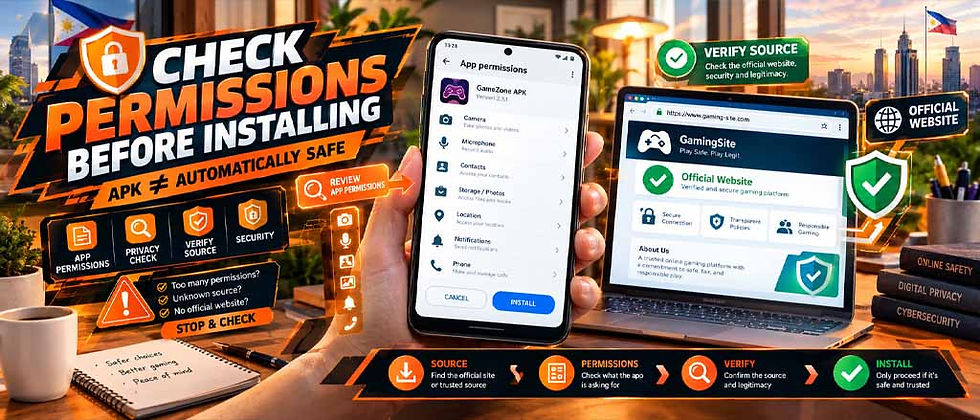
9. Review Android permissions
An app should not automatically receive broad access to sensitive device functions simply because it is a gambling application.
Pay attention to requests involving:
SMS
Contacts
Accessibility services
Calls
Device administration
Files or storage
Other sensitive device functions
A permission request by itself does not prove that an application is malicious. The important question is whether the permission is reasonably connected to the app's stated functionality and explained clearly.
Unexpected access to sensitive information is a reason to pause the installation and investigate the publisher and source further.
Why Google Play or Apple approval is not enough
Google Play
Google Play permits real-money gambling applications only when they meet its requirements. Among other conditions, developers need the appropriate gambling license for each relevant country or territory, must stay within the scope of that license, prevent underage access, restrict use in unauthorized locations and provide responsible-gambling information.
Google also says gambling apps must be free to download through Google Play and cannot use Google Play Billing for gambling transactions.
So:
Google Play listing = additional evidence, not proof of PAGCOR authorization.
Apple App Store
Apple's rules similarly require real-money gambling applications to have the necessary licensing and permissions where they are used and to be geographically restricted to those locations.
Apple also notes that licensing requirements can vary by region.
Therefore, an iPhone app being available through the App Store does not eliminate the need to verify its Philippine regulatory status.
Red flags that should stop you before depositing
Some warning signs are especially important:
Red flag | Why you should investigate |
PAGCOR logo without an official record | Logos can be copied |
Brand appears legitimate but domain differs | Could indicate a clone or unauthorized site |
Old license screenshot | Regulatory status may have changed |
“POGO licensed” claim | Offshore/Internet Gaming Licenses were cancelled |
APK from an unknown source | Publisher and software origin are harder to verify |
Unrelated publisher | The connection to the operator needs explanation |
Unusual sensitive permissions | Creates additional privacy/security concerns |
Multiple unexplained redirects | Final destination may not be the verified platform |
No identifiable operator | Accountability is unclear |
Game offering does not match authorization | The activity may fall outside the relevant scope |
No responsible-gaming information | Important player safeguards are missing |
PAGCOR's current offshore-gaming notice states that all Internet Gaming Licensees and Authorized Providers were cancelled effective December 15, 2024 following the offshore gaming ban. PAGCOR specifically warns that companies claiming to hold a valid offshore or Internet Gaming license from PAGCOR are fraudulent and unauthorized.
That makes an old POGO, IGL or offshore license certificate particularly poor evidence of current authorization.
Check the date of the PAGCOR information
Regulatory verification is not a one-time exercise.
PAGCOR's EGLD announcements show that regulatory requirements and licensing arrangements continue to develop. Its 2026 announcements include memoranda concerning the Unified Gaming License and other electronic-gaming regulatory matters.
For that reason, an old PDF, screenshot, blog post or license certificate should be treated as “needs verification” until it is confirmed against current PAGCOR information.
This is especially important when an app has changed:
Operator
Domain
Brand
Publisher
Game offering
Registration flow
Download source
A historical authorization does not automatically establish today's status.
PAGCOR authorization is Philippines-specific
PAGCOR verification answers a Philippine regulatory question. It should not be presented as authorization to operate in other Asian countries.
Singapore, for example, has its own Gambling Regulatory Authority (GRA). Singapore's framework requires gambling activities to be licensed or exempted, and the GRA separately regulates gambling operators and services.
For remote gambling, the GRA states that unlicensed remote gambling services are unlawful and identifies Singapore Pools as the only operator licensed to provide remote gambling services in Singapore.
The same principle applies across Asia: a Philippine authorization should not be used as a substitute for checking the laws and regulator applicable in Malaysia, Indonesia, Thailand, Vietnam, Singapore or another jurisdiction.
The final verification checklist
Before downloading, registering or depositing, check each item:
I know the exact app name.
I checked the publisher/developer.
I identified the actual operator.
I copied the exact domain.
I checked the brand through PAGCOR Guarantee.
The exact domain matches current PAGCOR information.
The operator or gaming system administrator matches.
The game offering is consistent with the relevant authorization.
I checked the final URL after redirects.
The app-store publisher makes sense in relation to the operator.
Any APK came from an official, verified source.
The app does not request unexplained sensitive permissions.
Age restrictions and responsible-gaming information are available.
I checked current information rather than relying on an old license screenshot.
If a major item cannot be verified, do not treat the app as verified yet.
Responsible gaming still matters
Regulatory authorization is about whether a gaming service is authorized; it is not a guarantee of winnings, withdrawals, game outcomes or financial returns.
PAGCOR's responsible-gaming framework emphasizes player protection, and its current information states that gambling is restricted to people aged 21 and above.
Anyone who chooses to gamble should do so only where legally permitted, observe applicable age restrictions and avoid using money needed for essential expenses.
A verified app can still involve gambling risk. The purpose of checking legitimacy is to reduce the risk of using an unauthorized or impersonating platform, not to suggest that gambling is a reliable way to make money.

The bottom line
The best way to check a legit scatter app is to verify the complete identity chain rather than trusting a logo or download page.
Start with PAGCOR Guarantee, then match the operator, gaming system administrator, registered brand, exact domain and game offering. After that, examine redirects, the app publisher, the download source and device permissions.
Google Play and Apple's App Store can provide additional safeguards, but neither replaces independent Philippine regulatory verification.
Most importantly, perform the check against current official information. A familiar brand, old license, .ph domain, payment method or app-store listing is not enough on its own.
About Asia Casino News
Asia Casino News (ACN) covers casino, gambling, gaming, regulatory, market and industry developments across Asia. Its editorial approach focuses on practical information that helps readers understand gaming products, regulations, operators and responsible-gaming considerations.

Sources
PAGCOR Guarantee: PAGCOR's public verification resource for legitimate online gaming providers.
PAGCOR Electronic Gaming Licensing Department: regulatory scope covering electronic casino, eBingo, sports betting, specialty games, poker and numeric games.
PAGCOR-accredited Gaming System Administrators and Registered Brands and Domain Names/URLs: official published records showing gaming administrators, game offerings, brands and domains.
PAGCOR Offshore Gaming Notice: confirms cancellation of Internet Gaming Licenses and Authorized Providers effective December 15, 2024.
PAGCOR Responsible Gaming: current age and responsible-gaming information.
Google Play Real-Money Gambling Policy: licensing, age, geographic and responsible-gambling requirements.
Apple App Store Review Guidelines: requirements for real-money gambling apps, including licensing and geographic restrictions.
Singapore Gambling Regulatory Authority: separate Singapore gambling licensing framework.
Competitor research: Recent 2026 Philippine licensing-verification articles were reviewed for search-intent and content-gap analysis, but official regulatory sources were prioritized for factual claims.


Comments