


MGM and Caesars reject prediction markets over gaming licence risk

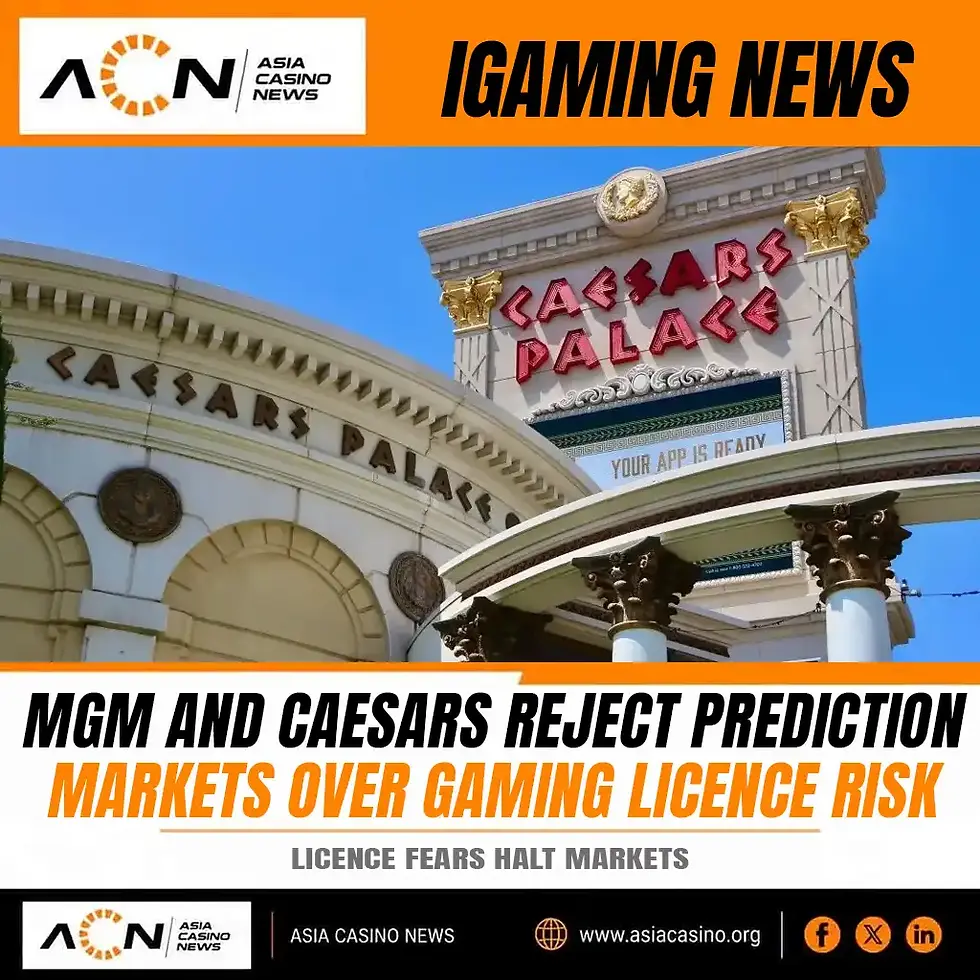
MGM Resorts International and Caesars Entertainment are staying out of the U.S. prediction-market sector as regulatory uncertainty raises concerns about the potential impact on their existing gaming licences.
The casino giants addressed the issue during the Global Gaming Expo (G2E) in Las Vegas, where MGM President and CEO Bill Hornbuckle and Caesars CEO Tom Reeg discussed the growing conflict between prediction-market operators and the state-regulated gaming industry.
For MGM and Caesars, the potential commercial opportunity is not enough to justify putting established casino, sports betting and iGaming licences at risk.

MGM and Caesars prediction markets plans remain off the table
MGM had previously considered entering the prediction-market business.
Hornbuckle said the company explored the possibility in early 2025, potentially through its BetMGM joint venture. The plan was ultimately abandoned after Nevada gaming regulators raised concerns that offering sports-related event contracts could affect MGM's gaming licences.
Caesars has reached a similar conclusion.
Reeg said Caesars would not enter the sector while the regulatory environment remains uncertain, particularly because the company operates across multiple U.S. jurisdictions with different gaming rules.
The decision highlights the difficult position facing established casino operators. Unlike new prediction-market platforms, MGM and Caesars already hold valuable state gaming approvals that support their land-based casinos, sportsbooks and online gambling operations.
Entering an uncertain market therefore carries a risk that extends well beyond a single new product.
Nevada has taken a hard line on prediction markets
Nevada has become one of the most important battlegrounds in the U.S. dispute over sports prediction markets.
The Nevada Gaming Control Board has taken enforcement action against several prediction-market operators and has argued that certain event contracts involving sports fall within the state's gaming regulatory framework.
In July, Nevada regulators reached an agreement that stopped Kalshi's sports prediction-market business in the state. In August, the Ninth Circuit ruled in favor of Nevada in litigation involving sports event contracts.
That regulatory position helps explain why MGM is reluctant to pursue the sector.
For a Nevada casino operator, a prediction-market product cannot be considered in isolation from the company's broader relationship with state gaming regulators.
The dispute is about more than sportsbooks
At the center of the conflict is a fundamental disagreement over how prediction markets should be classified.
Prediction-market operators generally argue that their event contracts are financial products regulated under federal commodities law. Traditional gaming companies and several state regulators argue that sports-related contracts can function much like wagers and should therefore be subject to state gambling laws.
That distinction has major commercial consequences.
State-licensed sportsbooks are generally required to comply with local rules covering licensing, taxation, responsible gaming, consumer protections and other regulatory obligations.
Prediction-market operators argue that a different federal regulatory framework applies to their products.
The competing positions have produced litigation across several U.S. states, creating an increasingly complicated regulatory environment for the wider gaming industry.
Casino executives question prediction-market safeguards
The MGM and Caesars CEOs also raised concerns about the consumer-protection framework surrounding prediction markets.
Hornbuckle questioned why some prediction platforms permit customers as young as 18 to participate when casino gambling and sports betting in many U.S. jurisdictions generally require customers to be at least 21.
Reeg raised a separate concern involving potential conflicts of interest.
He pointed to a prediction-market contract concerning the possibility of Caesars being acquired and questioned whether existing platform rules would have prevented him, as Caesars' chief executive, from trading on such a contract.
The example illustrates one of the broader questions facing prediction markets as they expand: whether rules designed for financial event contracts provide sufficient safeguards when the underlying events involve sports, companies or individuals with direct connections to the markets.
A growing divide between prediction markets and regulated gaming
The dispute has become a significant issue for the U.S. gaming industry.
The American Gaming Association has strongly criticized prediction markets, arguing that event-contract platforms can compete with licensed sportsbooks while operating under a different regulatory and taxation structure.
The industry's concern is particularly significant for operators such as MGM and Caesars because they have invested heavily in building regulated gambling businesses across multiple states.
Their reluctance to enter prediction markets suggests that, for established casino companies, the value of maintaining regulatory certainty may currently outweigh the potential growth opportunity offered by event contracts.
The position could also change if lawmakers or regulators eventually establish clearer rules for the sector.
Prediction markets face an uncertain road ahead
Prediction markets continue to expand in the United States despite opposition from parts of the casino and tribal gaming industries.
The regulatory picture, however, remains unsettled.
Federal and state authorities continue to disagree over the appropriate jurisdiction for sports-related event contracts, while court decisions have produced different outcomes across the country.
For MGM and Caesars, the immediate strategy is clear: protect their existing gaming licences rather than risk them in an emerging and contested market.
That approach could remain in place until regulators and courts provide greater certainty over whether prediction markets should operate as financial products, gambling products, or a distinct category requiring its own regulatory framework.
For the wider iGaming industry, the decision by two of the largest U.S. casino operators sends a significant signal. Prediction markets may be growing rapidly, but established gaming companies are not prepared to sacrifice valuable state licences to participate in that growth while the regulatory rules remain unsettled.
About Asia Casino News
Asia Casino News covers developments across the casino, iGaming, betting, regulation and gaming industries in Asia and international markets. Our coverage follows the legal, regulatory and commercial changes shaping the global gambling industry. Visit Asia Casino News for more industry news, analysis and gambling guides.

Sources
Yadude Books


Comments