


Pusoy hand combinations: understanding the 13-card structure


Understanding the pusoy combination system starts with recognizing that Pusoy is not played by creating three identical five-card poker hands. Instead, the standard game gives each player 13 cards, which must be organized into three hands of different sizes:
Front: 3 cards
Middle: 5 cards
Back: 5 cards
Together, these hands account for all 13 cards. Their positions also have a specific strength hierarchy. The Back hand should be the strongest, the Middle hand should fall between the Back and Front, and the Front should be the weakest.
This ordering is a central part of the game. Under the formal Chinese Poker rules described by Pagat, the Back must outrank the Middle, while the Middle must outrank the Front. If the hands do not follow this sequence, the player has created a foul or improperly arranged hand.
As a result, learning how to play Pusoy involves more than identifying the strongest individual poker combination. A player might hold a very strong five-card hand, yet the complete 13-card setup can still be invalid if that stronger hand is positioned ahead of a weaker hand in a way that violates the required order.
Pusoy should also be distinguished from Pusoy Dos. Pagat describes Pusoy as the Philippine name for Chinese Poker, while Pusoy Dos refers separately to Big Two. Therefore, people searching for Pusoy Dos rules may be referring to a different card game rather than the 13-card hand-setting format covered here.

The 13-card structure in Pusoy
A standard Pusoy deal gives each player 13 cards. Those cards must be separated into three hands: three cards for the Front, five for the Middle, and five for the Back.
Position | Cards | Possible Hands | Relative Strength |
Front | 3 | High card, one pair, three of a kind | Lowest |
Middle | 5 | Five-card poker combinations | Above Front |
Back | 5 | Five-card poker combinations | Highest |
The required relationship between the three positions is:
Back > Middle > Front
This rule applies to the finished arrangement, not just to the individual hands. For example, a Back containing a full house, a Middle containing a straight, and a Front containing a pair form a properly ordered hand.
The opposite arrangement would be a foul. If the Back is a straight while the Middle is a full house, the stronger hand has been placed below the weaker one. The individual combinations are valid poker hands, but their positions are incorrect.
This is an important part of understanding a pusoy combination. Players need to know both the strength of each hand and the position in which that hand can legally be used.
Pusoy card ranking
The standard ranking for five-card Pusoy hands, beginning with the strongest category, is:
Royal Flush
Straight Flush
Four of a Kind
Full House
Flush
Straight
Three of a Kind
Two Pair
One Pair
High Card
This hierarchy applies to the five-card Middle and Back. In the standard Chinese Poker rules described by Pagat, wild cards are not part of the game.
Royal Flush
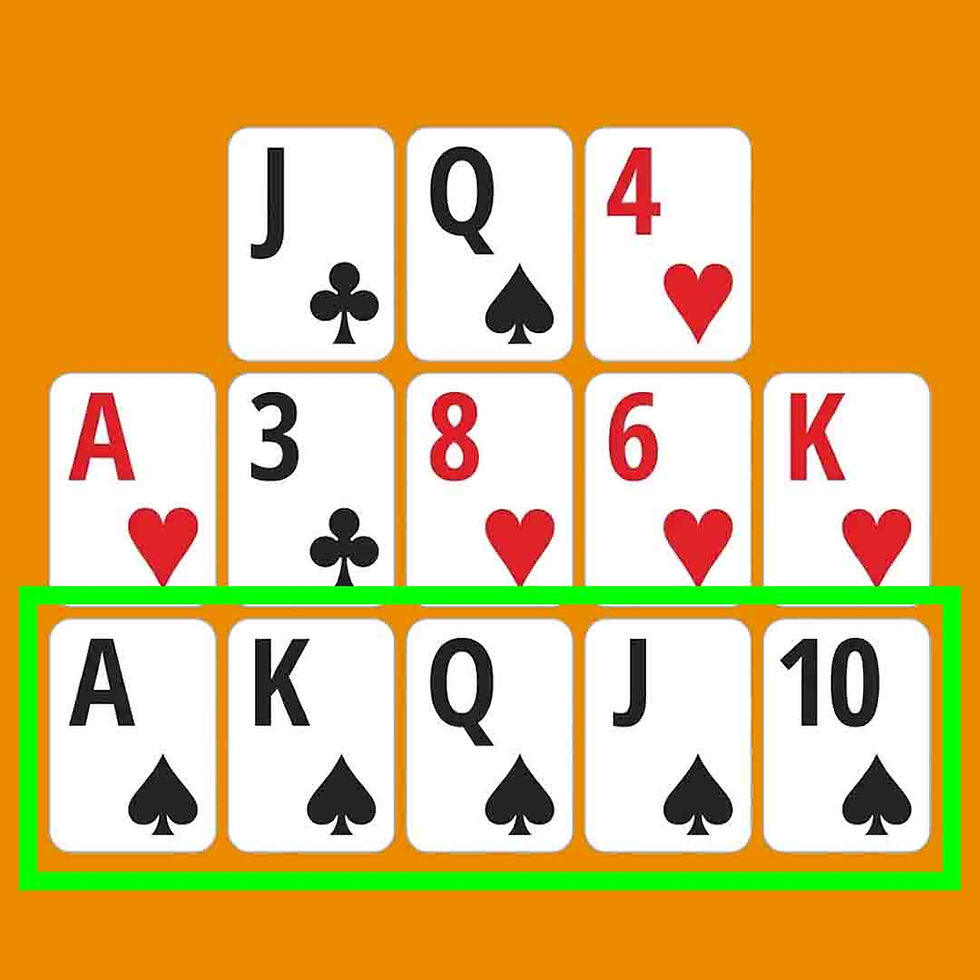
The royal flush is made from 10, Jack, Queen, King, and Ace of a single suit.
It occupies the highest position in the standard five-card hierarchy.
Straight Flush
Five consecutive ranks form a straight flush when all five cards belong to the same suit.
It is below a royal flush and above four of a kind.

Four of a Kind
This combination contains four cards with the same rank plus one different card.
The four matching cards determine the main value of the hand, while the remaining card functions as the kicker.

Full House
A full house contains a three-card group of one rank and a two-card group of another rank.
It ranks below four of a kind and above a flush in the standard pusoy dos ranking.

Flush
Five cards form a flush when they all belong to the same suit, even when their ranks are not consecutive.

Straight
A straight is made from five consecutive ranks. The suits may be different.
Some rules recognize A-2-3-4-5 as a five-high straight. A sequence such as Q-K-A-2-3 is generally not considered a normal straight. Since individual platforms can implement rules differently, anyone playing Pusoy Dos online should check the applicable rules before starting.

Three of a Kind
Three cards with the same rank make three of a kind.
This combination is also significant because three matching cards can fill the entire Front.

Two Pair
Two separate pairs appear in a five-card hand, with one additional card.
When two two-pair hands are compared, the higher pair is considered first.

One Pair
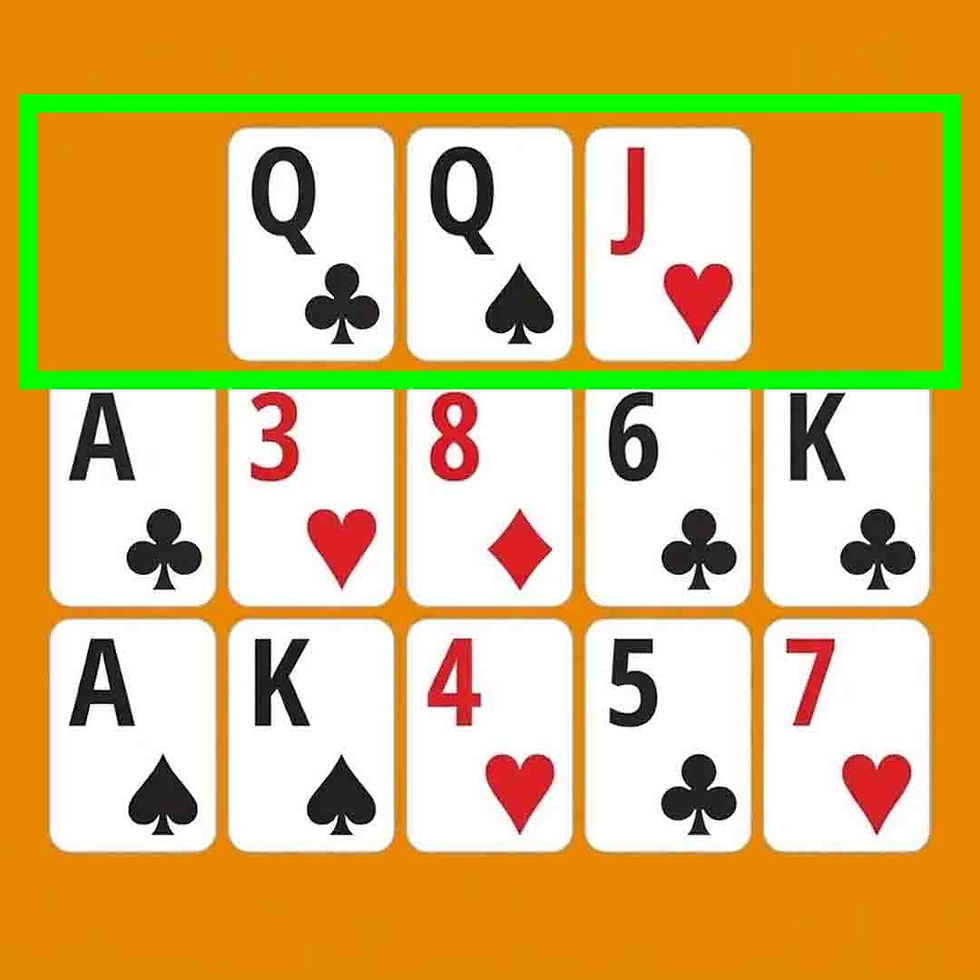
A pair consists of two cards sharing the same rank.
High Card
A hand that does not qualify as any stronger category is classified as high card.
Its value is determined by comparing the cards from the highest rank downward. High card is the lowest category in the standard five-card pusoy card ranking.

Which hands can be placed in each position?
A key part of the pusoy dos rules is the different role assigned to each section of the 13-card hand.
Hand Type | Front | Middle | Back |
High Card | Yes | Yes | Yes |
One Pair | Yes | Yes | Yes |
Two Pair | No | Yes | Yes |
Three of a Kind | Yes | Yes | Yes |
Straight | No* | Yes | Yes |
Flush | No* | Yes | Yes |
Full House | No | Yes | Yes |
Four of a Kind | No | Yes | Yes |
Straight Flush | No | Yes | Yes |
Royal Flush | No | Yes | Yes |
The standard three-card Front does not recognize three consecutive cards as a straight or three cards of the same suit as a flush.
Consequently, the Front has a limited set of normal outcomes:
Three of a Kind > One Pair > High Card
The five-card positions have access to the complete poker hierarchy. A full house, for example, can occupy the Middle or Back but cannot be placed in the Front because that position contains only three cards.
The same limitation applies to a flush. Three cards sharing a suit remain a three-card holding rather than becoming a five-card flush.
This positional distinction is essential for anyone learning how to play Pusoy. A conventional poker-ranking chart explains which combinations are stronger, but it does not by itself explain how those combinations must be distributed across a Pusoy hand.
Comparing Pusoy hands with the same combination
Two hands can belong to the same category while having different strengths. In those situations, the relevant card ranks determine the comparison.
Consider:
Hand A: K-K-9-7-3
Hand B: Q-Q-A-10-4
Both hands contain one pair, but Hand A has the higher pair because Kings outrank Queens. The Ace in Hand B does not make its pair stronger.
Two-pair hands are compared in stages. First, compare the higher pair. If those pairs are equal, compare the lower pair. If those are also identical, compare the remaining card.
High-card hands are handled by comparing the highest cards first. If those match, move to the next-highest card and continue until a difference appears.
For flushes, the ranks of the cards determine the comparison rather than the suits themselves. The same general principle applies to other equal-category hands: the category identifies the combination, while the relevant ranks and kickers determine which hand has greater value.
Kickers can therefore matter when the principal combinations are otherwise equivalent.
A complete tie may not be handled identically by every Pusoy implementation. Some online versions provide their own procedures for tied hands, so the rules of the particular Pusoy Dos online platform should be consulted when necessary.
How to arrange a 13-card Pusoy hand
To understand how to play Pusoy, it helps to approach the deal as one connected puzzle. Choosing a hand for one position changes the cards available for the other two.
1. Review the full deal
Look at all 13 cards before committing to a layout. Search for potential combinations, including:
Royal flush
Straight flush
Four of a kind
Full house
Flush
Straight
Three of a kind
Two pair
One pair
Finding the strongest five-card combination does not automatically tell you which cards belong in the Back. That choice is useful only if the remaining cards can still produce a legal Middle and Front.
2. Consider what the selection leaves behind
Once a possible Back has been identified, examine the eight unused cards.
They must be divided into:
Five cards for the Middle
Three cards for the Front
The resulting Middle has to outrank the Front. If it does not, another arrangement must be considered.
3. Evaluate the layout as a whole
The three positions should always be checked together:
Back > Middle > Front
This prevents a common structural error. A player may create three individually recognizable poker hands but still produce a foul because they are arranged in the wrong order.
For example, a full house in the Middle cannot sit beneath a straight in the Back. The stronger five-card hand has to occupy the higher position.
4. Build the Front using its limited ranking
Only three cards can be placed in the Front. Under the standard treatment, its useful ranking is:
Three of a Kind > One Pair > High Card
A sequence of three cards is not treated as a standard straight, and three cards sharing a suit do not qualify as a flush in this position.
5. Account for every card
The completed layout must use the entire deal:
3 + 5 + 5 = 13 cards
Each card belongs to one position only. Nothing should be left unused, duplicated, or assigned to two hands.
The central challenge of the Pusoy game is therefore the arrangement itself. Players are not simply searching for the strongest individual poker combination. They must distribute all 13 cards among the Front, Middle, and Back while keeping every hand legal and maintaining the required order from weakest at the Front to strongest at the Back.
Pusoy combination examples: correct placement, fouls, and game differences
Pusoy is not simply a matter of finding the strongest poker hands in a 13-card deal. The cards have to be divided into three differently sized hands, and the resulting hands must be arranged in the proper strength order.
A conventional deal is organized as follows:
Front: 3 cards
Middle: 5 cards
Back: 5 cards
The required progression is from the weakest section at the Front to the strongest section at the Back:
Front < Middle < Back
This rule explains why a strong pusoy combination can still be part of a losing or fouled arrangement. The poker hand itself may be perfectly legitimate; its position within the 13-card layout may be the problem.
Example of a legal arrangement
Consider this distribution:
Front: A♥ A♣ 7♦ - One Pair Middle: 9♠ 10♥ J♦ Q♣ K♠ - Straight Back: Q♠ Q♥ Q♦ 8♣ 8♦ - Full House
The three sections have increasing strength:
One Pair → Straight → Full House
The Back contains the stronger five-card hand, while the Middle is stronger than the Front.
This arrangement therefore follows the conventional hierarchy.
The example illustrates an important feature of Pusoy: a player must consider both the identity of each hand and its assigned position.
Example of a fouled arrangement
Now examine this layout:
Front: A♣ 9♦ 3♠ - High Card Middle: J♠ J♥ J♦ 5♣ 5♦ - Full House Back: 4♠ 5♥ 6♦ 7♣ 8♠ - Straight
The Front is weaker than the Middle, so there is no problem between those two sections.
The issue is the five-card pair.
A Full House outranks a Straight, yet the Full House has been placed in the Middle and the Straight in the Back. That reverses the required relationship.
The result is a foul under the conventional structure.
It is worth separating two ideas here:
The Full House is a valid poker hand.
The Straight is a valid poker hand.
Their positions make the complete Pusoy layout invalid.
That distinction is central to understanding Pusoy combinations.
Why three Queens in the Front are not automatically the best choice
Suppose a player receives three Queens among the 13 cards.
One possible arrangement begins with:
Front: Q♠ Q♥ Q♦ - Three of a Kind
At first, this looks like an obvious way to use the cards. But placing the Queens in the Front permanently removes them from the remaining ten cards.
Those ten cards now have to supply both the Middle and the Back.
If the remaining cards cannot form two hands in the correct order, the three-of-a-kind Front has created a problem rather than solving one.
This is an important principle when learning how to play Pusoy. The cards should be assessed as a complete group. A powerful three-card hand may be less useful than a modest Front if the latter leaves enough strength for the two five-card sections.
The best arrangement is therefore not necessarily the one containing the strongest individual Front.
Pusoy versus Pusoy Dos
The names are similar, but the games have different objectives and structures.
In Philippine usage, Pusoy commonly refers to the 13-card game also known internationally as Chinese Poker. The entire deal is arranged into three hands before those hands are compared.
Pusoy Dos is a different game associated with Big Two. Players play card combinations during successive turns and try to dispose of their cards. It does not use the same three-hand construction.
Pusoy / Chinese Poker | Pusoy Dos |
13 cards are arranged into three sections | Cards are played progressively |
Front contains 3 cards | No permanent Front |
Middle contains 5 cards | No permanent Middle |
Back contains 5 cards | No permanent Back |
Position and hand strength are linked | Players focus on playing cards and emptying their hands |
This difference matters when searching for pusoy dos rules. Instructions for Big Two should not be substituted for rules governing the 13-card Pusoy format.
The same warning applies to pusoy dos ranking. Its ranking system belongs to a different game and should not be confused with the poker categories used in Pusoy.
Pusoy rules can include variations
The three-hand structure is fundamental, but additional rules do not have to be identical in every game.
Depending on the particular ruleset, players may encounter provisions for:
Royalties
Special 13-card formations
Sweep or scoop bonuses
Banker arrangements
Position-specific rewards
Settlement procedures
Some versions give special treatment to unusual complete-card patterns, including six pairs, three straights, three flushes, or an Ace-through-King sequence.
Those formations should not be assumed to have special value everywhere. Their status depends on the rules governing the particular game.
The same applies to royalties. A hand that earns an additional payment in one version may receive no extra reward under another.
What to check before playing Pusoy online
A pusoy online game can introduce rules that differ from those used at another table or platform.
Before arranging a hand, check the platform's rules for:
How fouled hands are handled
Whether equal-strength neighboring hands are allowed
Which royalties apply
Which special hands receive bonuses
How sweeps are calculated
How final payments are settled
The treatment of equal-strength sections can be particularly important. Some implementations require the higher position to be strictly stronger than the lower one, while other Chinese Poker rules may permit particular equal-strength situations.
As a result, the same card arrangement may receive different treatment under different rulesets.
The same principle applies to pusoy dos online. A digital Big Two game should be evaluated using its own rules because it is not the same game as Pusoy.
Common questions about Pusoy combinations
What is the highest Pusoy combination?
For a standard five-card hand, the highest conventional category is the Royal Flush.
The usual five-card hierarchy is:
Royal Flush → Straight Flush → Four of a Kind → Full House → Flush → Straight → Three of a Kind → Two Pair → One Pair → High Card
This sequence is useful for comparing the Middle and Back.
It does not, by itself, determine whether the complete 13-card layout is legal. The relative position of each hand must also be checked.
Can the Front contain a Straight?
Not in the conventional format.
The Front contains three cards, while a standard Straight requires five. Three consecutive ranks therefore do not normally qualify as a Straight.
The usual Front categories are:
High Card
One Pair
Three of a Kind
A specific house rule can change this, so players should follow the rules of the particular game being played.
Can three cards of the same suit make a Front Flush?
Not under the standard poker definition.
A Flush requires five cards of the same suit. Three suited cards in the Front are therefore insufficient.
If a variation assigns those three cards special value, that treatment comes from the variation rather than the conventional Flush ranking.
Can a Full House be placed in the Front?
No.
A Full House requires five cards: three cards sharing one rank and two cards sharing another. The Front contains only three cards.
A conventional Full House can therefore be used in the Middle or Back.
What happens if the Middle is stronger than the Back?
Under the normal ordering, the layout is fouled.
For example:
Middle: Full House Back: Straight
The Full House is the stronger poker hand, but it occupies the lower five-card position.
The fault is therefore caused by placement, not by the quality of the individual combinations.
Is Pusoy the same as Chinese Poker?
In Philippine usage, Pusoy commonly refers to the 13-card game known internationally as Chinese Poker.
The familiar structure uses three cards in the Front and five cards in each of the other two sections. Scoring, royalties, and special-hand rules can still differ.
Pusoy Dos is a separate Big Two-style game.
Are special Pusoy hands universal?
No.
Special 13-card formations and bonus systems depend on the rules being used. A formation can qualify for an additional reward in one game and have no special status in another.
Players should check the applicable rules before relying on any special-hand bonus.
Understanding Pusoy card ranking
A pusoy card ranking reference explains the relative value of poker categories. It does not completely describe how a legal Pusoy layout is built.
For the five-card sections, the conventional hierarchy is:
Royal Flush → Straight Flush → Four of a Kind → Full House → Flush → Straight → Three of a Kind → Two Pair → One Pair → High Card
For the three-card Front, the standard possibilities are:
Three of a Kind → One Pair → High Card
Consider two five-card hands: a Full House and a Straight.
If the Full House is assigned to the Back and the Straight to the Middle, their relative positions match their strength.
Reverse those assignments, and the same two poker hands now produce a foul.
This is why a Pusoy player needs to understand two separate concepts:
Hand ranking: which combination beats another?
Hand placement: which position can legally contain that combination?
Both are necessary to construct the complete deal.
The remaining cards matter just as much
A common mistake is to judge a potential Front without examining what will be left behind.
Every card committed to the Front disappears from the pool available to the Middle and Back. The Middle creates the same constraint for the final five cards.
This makes Pusoy a problem of allocation.
For example, three matching cards may be extremely valuable in the Front, yet those same cards might be needed to complete a much stronger five-card hand. Choosing between those possibilities requires looking at the entire deal.
A weaker Front can sometimes produce a much more effective overall arrangement because it preserves useful cards for the larger hands.
The finished layout matters more than the strength of any one section considered in isolation.
A practical Pusoy arrangement check
When working through a new 13-card deal, consider these points:
Identify the major combinations available across the full hand.
Notice which cards are useful in several potential constructions.
Test different Front possibilities.
Examine the five-card hands that remain after each option.
Reserve the strongest suitable five-card group for the Back.
Make sure the Middle does not outrank the Back.
Make sure the Front does not outrank the Middle.
Apply any additional rules governing bonuses, royalties, special hands, or equal-strength sections.
The central test is:
Front < Middle < Back
That relationship is the foundation of a legal pusoy combination. Poker rankings explain the strength of individual hands, while the three-position structure determines whether those hands form a valid 13-card arrangement.
For online play, the rules published by the specific platform should take precedence whenever they differ from the conventional format. This is especially relevant to ties, special formations, royalties, bonuses, and settlement procedures.
About Asia Casino News
Asia Casino News is an independent digital publication covering the global iGaming industry, with a particular focus on Asia-Pacific. Our coverage includes ongoing analysis of casino games, gambling regulation, iGaming companies and developments affecting the global gambling industry.

Sources
Pagat - Chinese Poker card game rules
California Attorney General - Palomar Card Club Chinese Poker Rules & Standards of Play
PokerFuse - How to Play Chinese Poker
PokerNews - Chinese Poker Rules
WPT Global - How to Play Chinese Poker
Pusoy Online - Pusoy Hand Rankings


Comments