


JILI Bingo Games in the Philippines: What Players Should Know


JILI Bingo is not simply one digital version of traditional bingo. In the Philippines, JILI has multiple electronic bingo titles, and individual games can use different numbers of patterns, cards and additional features.
PAGCOR's list of EGLD-approved electronic games dated March 19, 2026 identifies 13 JILI titles under eBingo Games. That provides a stronger basis for identifying the Philippine JILI Bingo catalogue than relying on casino or affiliate listings alone.
The more important point, however, is that the titles do not all work in exactly the same way.
JILI's first-party descriptions show examples such as Super Bingo with 19 patterns and Collection Reward and Bonus Game features; Lucky Bingo with 16 patterns, Golden Ball and Bonus Game mechanics; iRich Bingo with 19 patterns, Wild Ball and Collection Reward features; and Bingo Adventure with 16 patterns, Golden Ball, Bonus Game, Golden Wheel and Free Ball features.
That means someone searching for jili bingo games Philippines should look beyond the title list. Understanding how the cards, patterns, number draws and bonus mechanics interact is essential to understanding the actual game.

Which JILI Bingo games are documented by PAGCOR?
PAGCOR's March 19, 2026 JILI approval document lists the following 13 games as eBingo titles:
JILI Bingo Title | PAGCOR Game ID | Game type |
Bingo Adventure | 177 | eBingo |
Bingo Carnaval | 148 | eBingo |
Calaca Bingo | 149 | eBingo |
Candyland Bingo | 216 | eBingo |
Fortune Bingo | 139 | eBingo |
Go Goal Bingo | 178 | eBingo |
iRich Bingo | 122 | eBingo |
Jackpot Bingo | 174 | eBingo |
Lucky Bingo | 150 | eBingo |
Magic Lamp Bingo | 217 | eBingo |
Pearls of Bingo | 195 | eBingo |
Super Bingo | 151 | eBingo |
West Hunter Bingo | 173 | eBingo |
The document also records the game version associated with each entry. For example, Bingo Adventure is listed as Game ID 177, while iRich Bingo is Game ID 122 and Super Bingo is Game ID 151.
This matters because game names alone do not necessarily identify every technical implementation a player may encounter. Version and game-ID information can provide a more precise way of distinguishing an approved game from a similarly named listing.
PAGCOR's Electronic Gaming Licensing Department regulates local electronic bingo operations and processes approval requests for electronic gaming platforms and the games or content deployed through them.
The regulator's role does not mean that every website displaying the JILI logo is automatically a legitimate Philippine gaming site. The operator and gaming site still need to be verified separately.
How JILI Bingo works: cards, numbers and patterns
At its simplest, JILI Bingo combines familiar bingo concepts with digital game mechanics.
A round generally involves:
Selecting or receiving one or more bingo cards.
Paying the applicable wager associated with the selected cards.
Starting the round.
Having numbers generated and displayed by the game.
Matching drawn numbers against numbers on the cards.
Completing one or more predetermined patterns.
Receiving the corresponding prize according to the game's paytable.
Potentially entering an additional feature or bonus stage, depending on the title.
PAGCOR's definition of electronic bingo describes bingo or bingo-styled cards and numbers that are randomly generated through an RNG or another approved drawing mechanism. It also describes winning as completing a predetermined pattern or combination and receiving the corresponding prize shown in the paytable or jackpot.
The key word is predetermined.
Players are not normally deciding which number will be drawn. Instead, the game determines the outcome through its approved random-number or drawing system, while the card layout and game's predefined patterns determine whether the resulting numbers create a winning combination.
Cards are not just decoration
A card determines the collection of numbers against which the drawn numbers are matched.
Some JILI titles allow multiple cards to be played during a round. The exact card limits and mechanics can vary by title, so players should read the individual game's information rather than assume that every JILI Bingo title has identical settings.
More cards can create more potential combinations to monitor, but they also change the amount being wagered. Buying additional cards should therefore be understood as an additional betting decision, not as a guaranteed improvement in the outcome of a particular round.
Winning patterns determine the result
Traditional bingo often teaches players to think in terms of a row, column or full card. JILI's digital titles can use more elaborate predefined patterns.
This is one reason the term "payline" can become confusing.
JILI's own pages use the word Paylines when describing the number of patterns in some games. For example, Super Bingo lists 19 patterns, while Lucky Bingo and Bingo Adventure each list 16 patterns.
For accuracy, however, readers should understand these as game-specific winning patterns, not automatically as conventional slot paylines.
A slot game's payline normally describes a route through reels and symbols. A bingo pattern instead identifies a particular arrangement or combination of matched numbers on the card.
The game's own paytable and interface remain the authoritative source for determining which patterns qualify and what each pattern pays.
Are JILI Bingo "paylines" really paylines?
Not in the same sense as a conventional slot machine.
JILI's product pages use "Paylines" as a field and then describe the number of patterns-for example, "19 patterns" for Super Bingo and iRich Bingo and "16 patterns" for Lucky Bingo and Bingo Adventure.
For readers, the practical distinction is more important than the terminology.
A pattern is a predefined arrangement that can be completed by the numbers marked on a bingo card. A slot payline is normally a specified symbol path across reels.
Using the word "payline" because JILI's own page does so is understandable, but readers should not assume that a 16-pattern JILI Bingo game operates like a 16-payline slot.
That distinction helps explain why articles that simply describe these games as "bingo slots" can leave out important information.

How iRich Bingo works
iRich Bingo is one of the clearest examples of JILI adding additional mechanics to the familiar bingo structure.
JILI's first-party page identifies iRich Bingo as a Bingo game with 19 patterns and a Collection Reward feature. The page also identifies a Wild Ball feature.
Supporting game documentation describes a round beginning with an initial draw of 30 numbers. After those numbers have been drawn, the game can provide an opportunity to purchase additional balls, subject to the game's conditions.
The important mechanics include:
Multiple bingo cards can be used.
Numbers are drawn and matched against the cards.
Winning patterns determine eligible prizes.
After the initial 30-number stage, additional balls may become available.
A Wild Ball can appear under the game's feature conditions.
Collection-style bonus mechanics can provide another layer beyond the basic bingo pattern.
The Wild Ball is particularly important because it changes how a later draw can interact with the card. Supporting documentation describes a Wild Ball event in which the player can select from candidate numbers, subject to the feature's rules.
That is very different from simply waiting for traditional bingo numbers.
It also demonstrates why players should read the individual game's rules before assuming that all JILI Bingo titles have identical extra-ball mechanics.

How Super Bingo works
JILI's Super Bingo page identifies:
19 patterns
Collection Reward
Bonus Game
Its description centers on collecting golden balls and connecting numbers to trigger additional reward opportunities.
The game's structure therefore extends beyond simply matching numbers on a card. A player needs to understand both the base bingo patterns and the collection or bonus mechanisms attached to the game.
This is an important example of why the phrase "bingo" alone does not describe the complete gameplay.
A player familiar with traditional bingo might understand the idea of matching numbers, but that knowledge does not automatically explain what happens when Super Bingo's Collection Reward or Bonus Game is activated.
The actual rules and paytable presented within the game should therefore take priority over generic bingo terminology.
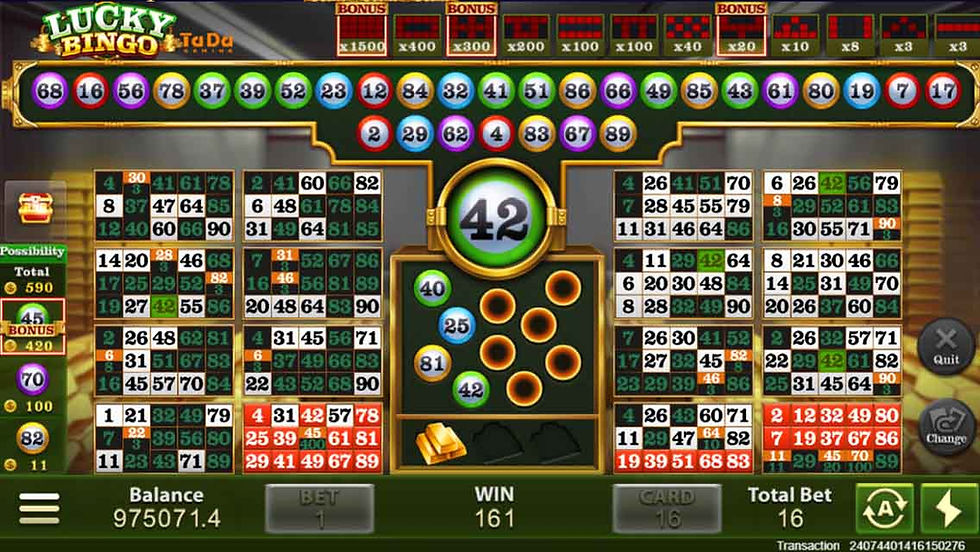
How Lucky Bingo works
Lucky Bingo uses a different configuration.
JILI's first-party page identifies 16 patterns, along with Golden Ball and Bonus Game features.
The game description also identifies:
Up to 16 cards
Up to 10 additional balls
Wild Ball possibilities
Golden Treasury mechanics
Golden Ball collection
This creates several decision points within a round.
The player is not simply waiting for numbers to appear. The number of cards, the possibility of additional balls and the interaction of special features can all affect the amount wagered and the way a round develops.
That does not mean the player can control the random outcome. It means the game includes additional wagering and feature mechanics around the underlying random number process.

How Bingo Adventure works
Bingo Adventure also uses 16 patterns, but its presentation adds a distinct theme and feature structure.
JILI lists:
Golden Ball
Bonus Game
Golden Wheel
Free Ball
The first-party description explains that the game uses bingo ball connections and a bonus sequence associated with the themed gameplay.
The inclusion of a Free Ball is particularly relevant to understanding the difference between titles. A feature such as this can affect the number of balls available without turning the underlying random process into something predictable.
Bingo Adventure therefore illustrates the broader point: two JILI Bingo games can share the same fundamental idea-match numbers to patterns-while providing materially different bonus mechanics.
Are JILI Bingo games Philippines based on random outcomes?
Yes. Random selection is a core part of electronic bingo.
PAGCOR's regulatory materials describe eBingo as a game of chance that uses bingo or bingo-style cards, with numbers generated randomly through a Random Number Generator (RNG) and presented electronically.
Understanding this is important because it addresses one of the most common misconceptions about bingo.
Does a nearly completed card make a number more likely?
No. Being close to completing a winning pattern does not make the missing number more likely to appear.
For example, imagine that a card needs only one remaining number to complete its pattern. A player may naturally feel that the missing number is "due." However, the fact that the card is close to winning does not alter the random-number selection process.
The same principle applies to numbers that have already been drawn or numbers a player has been waiting for. Previous results do not, by themselves, make a particular future number more or less likely.
Having multiple numbers already matched also does not guarantee that the next draw will produce the number needed to finish the pattern.
Some games may display information indicating which numbers could potentially produce a win. That information describes possible outcomes; it does not predict the number that the RNG will actually generate.
This distinction matters when considering features such as purchasing additional balls. An extra-ball option is a separate game mechanic that may involve an additional cost. It should not be viewed as a way of making a particular desired number more likely or "due."
What is the RTP of JILI Bingo?
RTP requires some care when discussing JILI Bingo.
Online searches often display RTP percentages for JILI slot games. Those percentages should not automatically be applied to JILI Bingo titles because RTP is tied to the configuration of a particular game.
A slot game's published RTP does not establish the RTP of a separate bingo game.
PAGCOR's regulatory framework does provide a general RTP range for electronic bingo. Its published framework states that the RTP for an electronic bingo game must be 88.00% to less than 97.00%.
However, this is a regulatory range for eBingo as a category. It does not demonstrate that every JILI Bingo title has a specific RTP within that range.
Therefore, players should distinguish between the general regulatory requirement and a title-specific RTP:
Title-specific JILI Bingo RTP: Requires verification.
Reliable RTP for an individual title: Should be supported by the game's relevant documentation, approved configuration, or another directly applicable authoritative source.
This is especially relevant for titles such as iRich Bingo, Super Bingo, Lucky Bingo, or other individual games. A webpage that simply takes the RTP of a JILI slot and assigns the same figure to a bingo title without title-specific evidence should be treated cautiously.
RTP also does not mean that a player is guaranteed to receive a particular percentage of their wagers during one playing session. It is a theoretical, long-term statistical measure based on the game's defined configuration.
Is JILI Bingo legitimate or PAGCOR-approved?
Game approval and website legitimacy are two different issues.
According to the supplied PAGCOR information, its March 19, 2026 JILI document lists 13 JILI titles as EGLD-approved electronic games. This supports the narrower claim that those specific JILI titles appeared on PAGCOR's approved electronic-game list on that date.
It should not be interpreted as confirmation that every website offering a JILI game is automatically authorized.
PAGCOR's Electronic Gaming Licensing Department regulates local gaming operations that include traditional bingo, eBingo, eCasino games, sports betting, specialty games, and other approved offerings. PAGCOR also provides regulatory information concerning accredited gaming system administrators and registered brands and domains.
PAGCOR has separately advised the public to verify legitimate gaming websites using its regulatory information rather than assuming that a website is legal simply because it features a particular game or gaming brand.
A practical legitimacy check therefore requires two separate verifications:
Is the game approved? Check whether the specific JILI title appears in the applicable PAGCOR approved-game information.
Is the gaming website authorized? Check the relevant PAGCOR registration or licensing information for the operator, brand, and domain.
Simply finding JILI Bingo on a website does not establish that the website itself is authorized.
Bingo Plus, downloads, and JILI Bingo access
Searches for JILI Bingo games Philippines may also bring up phrases such as "Bingo Plus PAGCOR legit" and "Bingo Plus download." These terms should not be treated as proof that a particular JILI Bingo title is approved or that a particular gaming website is authorized.
Bingo Plus is a platform or brand-related search term, whereas JILI refers to the game provider associated with the titles discussed here. The gaming website should therefore be verified independently from the game provider.
The same principle applies to an application download. Installing an app does not, by itself, demonstrate that the application or its operator has the required authorization.
For players researching how to play JILI Bingo in the Philippines, it is safer to begin with current PAGCOR regulatory information and verify the exact gaming brand and domain being used.
The same verification approach is useful when researching JILI Bingo rules and mechanics or looking into JILI Bingo bonus features explained: understand the game's stated mechanics separately from the regulatory status of the platform offering it.
Because gaming websites, domains, and regulatory statuses can change, the relevant brand and domain should be checked against current regulatory information rather than relying solely on the presence of a JILI game or the name of a platform.
What should players check before playing?
Before opening a JILI Bingo title, it is useful to check five things.
1. Identify the exact game
Do not assume that "JILI Bingo" means one universal ruleset.
Check whether the title is iRich Bingo, Super Bingo, Lucky Bingo, Bingo Adventure or another game.
2. Read the pattern information
Look at the game's displayed winning patterns and paytable.
Do not assume that a pattern in one JILI Bingo title works the same way in another.
3. Understand additional-ball mechanics
Some titles include extra balls or features that can involve an additional wager.
Know the cost and conditions before activating them.
4. Check the bonus features
Wild Balls, Golden Balls, Collection Rewards, Bonus Games, Golden Wheels and Free Balls can change the way a round works.
Understanding the feature is more useful than simply knowing that it exists.
5. Verify the operator separately
A genuine JILI game does not automatically make the host website legitimate.
Verify the relevant Philippine gaming operator and domain through current PAGCOR information.
Most importantly, remember that these checks explain the game-they do not create a method for predicting random outcomes.
Final takeaway
JILI Bingo games in the Philippines combine a recognizable bingo concept with considerably more varied digital mechanics.
PAGCOR's March 19, 2026 approval list identifies 13 JILI eBingo titles, giving readers a reliable starting point for understanding which games were officially documented at that point.
The individual titles can then differ substantially.
Super Bingo uses 19 patterns with Collection Reward and Bonus Game features. iRich Bingo also uses 19 patterns and adds Wild Ball and Collection Reward mechanics. Lucky Bingo uses 16 patterns with Golden Ball, Wild Ball, Golden Treasury and additional-ball features, while Bingo Adventure uses 16 patterns alongside Golden Ball, Golden Wheel, Bonus Game and Free Ball features.
The central lesson is that JILI Bingo should not be treated as a single, simple game.
The cards, number draws, winning patterns, extra balls and bonus features all form part of the actual mechanics. Random outcomes remain random, so a nearly completed card does not make a particular number "due."
RTP deserves similar caution. PAGCOR publishes a regulatory RTP range for eBingo, but that should not be confused with a verified RTP for an individual JILI Bingo title. Title-specific figures remain Needs verification unless supported by appropriate game documentation.
For Philippine players, legitimacy also requires looking beyond the game itself. Verify the operator and domain separately through PAGCOR's current regulatory information.
Understanding these distinctions gives readers a much clearer picture of what JILI Bingo actually involves-without presenting bingo as an easy-win game or implying that its additional mechanics can overcome random outcomes.
About Asia Casino News
Asia Casino News is an independent digital publication covering the global iGaming industry, with a particular focus on Asia-Pacific. Our coverage includes ongoing analysis of casino games, gambling regulation, iGaming companies and developments affecting the global gambling industry.

Sources
PAGCOR - Official regulatory information
JILI Games - Super Bingo


Comments